Content SEOWords
Answer what people search
Service pages, guides and FAQs written for the searches your customers make.
You win whenWorth ranking

Content, technical and AI search
Content gives Google something worth ranking. Technical SEO makes sure Google can reach it, read it and trust it, and the same foundations decide whether AI tools can use your site.
Service pages, guides and FAQs written for the searches your customers make.
Crawling, indexing, speed, canonicals, redirects and structured data, fixed in order of impact.
Crawler access and clean structure decide whether AI tools can use your pages. See . Generative Engine Optimisation
What holds sites back
Crawl paths and sitemaps that work.
Canonicals that point Google to the right page.
Faster pages, starting with mobile.
Clean redirects after every site change.
Every part of making your site easy for Google to crawl, read and rank.
My method
A technical SEO audit can turn up hundreds of warnings. Most don't matter. I find the few that are holding your site back and fix those first.
Every page checked the way Google sees it: status codes, redirects, canonicals and links.
Indexing reports, crawl stats and Core Web Vitals, compared with what the crawl found.
Each problem weighed by the pages it affects and the traffic those pages could earn.
Your key pages against competitors on mobile load time and stability.
Fixes go in by sprint, get checked in staging, ship with the release and are monitored after.
The priority score
An audit can list hundreds of warnings. I rank them by how much each one holds back your search traffic, and the top of the list gets fixed first.
What you get
Site health, indexing and speed in one short, visual report, written for business owners rather than developers.
Indexing, errors and speed combined, tracked month by month.
Who loads faster, and who outranks you.
Pages where traffic or indexing is slipping.
Clear jobs in priority order, aimed at what matters most.
Key pages checked before and after every release.
Industries
The challenge
Online stores create duplicate URLs through filters, variants and sorting. Google wastes time on them while new products wait to be indexed.
Online stores
for a comparison query
Waterfilters Online
01What customers ask
02The answer they see
Why are my new products not showing on Google?
03What AI looks for
04What I'd fix first
Locations
Auckland-based, working with businesses across New Zealand, remotely or in person. AI answers change from city to city, and your tracking follows that.
Plus clients across the rest of New Zealand
Local questions I track
What AI weighs locally
Your tracked questions include Auckland and its suburbs, so the report shows who AI recommends there.
Real results
From client work shown on seoexpertauckland.co.nz
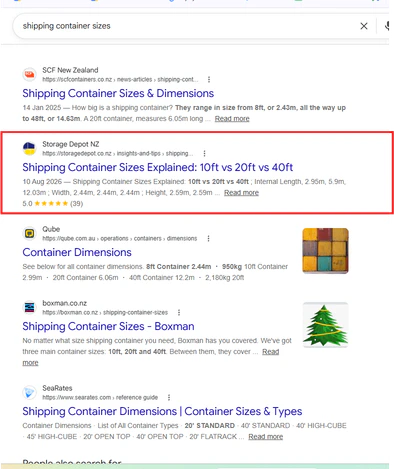 5 posts, 6 months
“shipping container sizes”
Five posts drew 6,739 impressions in six months, including a ranking for “shipping container sizes”, once Google could crawl and index them properly.
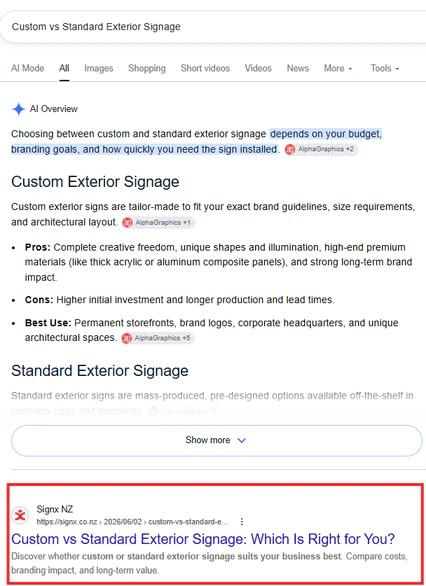 Page one result
“custom vs standard exterior signage”
Signx holds page one for a comparison search where Google shows an AI Overview first.
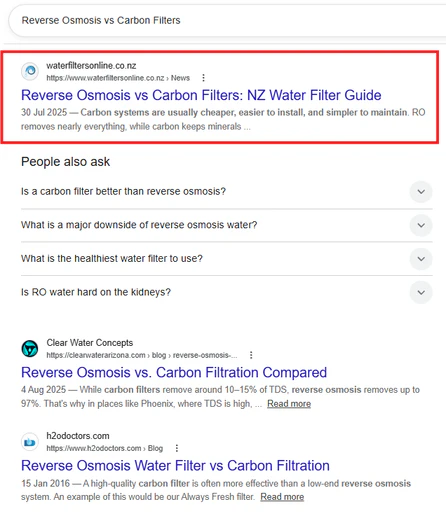 Position 1
“reverse osmosis vs carbon filters”
Comparison content on the store holds the top spot for a buyer’s question, with four related comparisons alongside it.
Asked about technical SEO
why is google not indexing my new page
Indexing and crawling
Real questions business owners ask about technical SEO. Tap one to see how I'd approach it.
Questions
Technical SEO services fix the parts of your website that decide whether Google can find, read and rank it: crawling and indexing, site structure, canonical tags, redirects, page speed, mobile usability and structured data. I find the issues, rank them by impact and get them fixed.
A site can work perfectly for visitors and still confuse Google. A technical SEO audit looks at the site the way Google does: which pages it can reach, which it indexes, and which version of each page it treats as the original.
Sometimes. Google has seen the page and decided not to index it yet, usually because it looks thin, duplicated or unimportant. For key service pages it's worth fixing. For tag pages and filters it's often fine.
They're one signal among many, and rarely the reason a page ranks or doesn't. Slow pages do lose visitors, especially on mobile, which is why speed fixes usually pay for themselves.
For most businesses it is. Structured data SEO helps Google understand your business, services, products and reviews, and makes you eligible for richer results. It has to match what's on the page, or Google ignores it.
Before launch: a full list of old URLs and where each one redirects, matching titles and content on key pages, and a check of the staging site. After launch: crawl errors, indexing and rankings for the pages that brought traffic.
I work across WordPress, Shopify and custom-built sites. Each platform has its own common issues, and the audit notes what can be fixed in settings and what needs a developer.
Either. Depending on your setup, I can make fixes directly or write clear tickets for your developer with the exact change, the reason and how to check it's done.
I'm an independent SEO consultant rather than an agency. If you've been looking for technical SEO services in Auckland or a technical SEO audit in NZ, you work with me directly from the first crawl to every fix.
A technical SEO audit is fixed-price, based on the size of the site. Fixes are then scoped from what the audit finds, and I quote before any work starts.
Contact
Tell me your website and what's going wrong. I'll check how Google sees it and tell you what to fix first.